
Timeless Wisdom for
the Modern Soul
Deep philosophical insights drawn from the Vedic tradition, presented with clarity, warmth, and practical applicability for seekers of all backgrounds.
The Science of Self-Realization
At the foundation of Bir Krishna Das Goswami's teachings lies the Bhagavad Gita's central message: every living being is an eternal spiritual soul, qualitatively one with God yet quantitatively distinct. This fundamental understanding transforms one's entire worldview — from seeing the body as the self to recognizing oneself as an eternal servant of Krishna, the Supreme Personality of Godhead.
Drawing from Srila Prabhupada's translations and purports, Bir Krishna Das Goswami systematically presents the hierarchy of yoga systems, ultimately demonstrating that bhakti-yoga — the yoga of devotional love — is the most complete and accessible path for self-realization in the current age. His lectures skillfully bridge the gap between ancient Sanskrit texts and contemporary life situations, making these profound truths practically applicable.
He emphasizes that genuine self-realization is not a withdrawal from the world but a deeper engagement with it — seeing all beings as spiritual souls, offering all activities to Krishna, and cultivating a consciousness saturated with divine love and purpose.
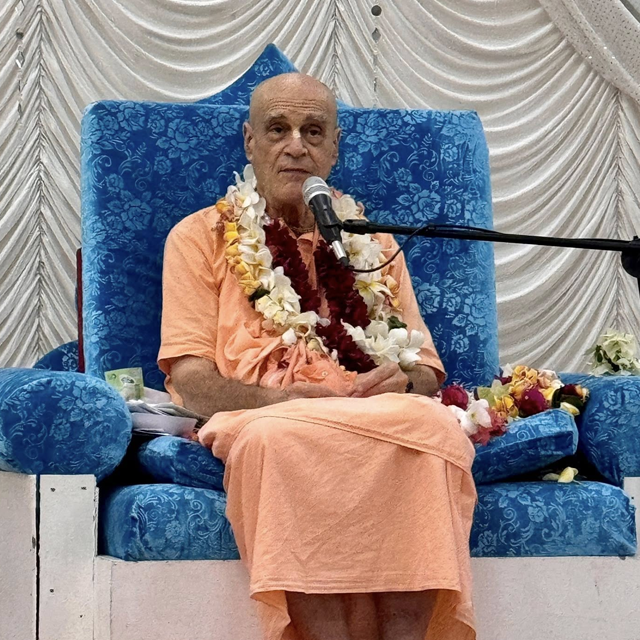
The Power of the Holy Name
Central to Bir Krishna Das Goswami's spiritual practice and teaching is the chanting of the Hare Krishna mahamantra: Hare Krishna, Hare Krishna, Krishna Krishna, Hare Hare / Hare Rama, Hare Rama, Rama Rama, Hare Hare. He explains this practice not as mere ritualistic repetition but as a direct communication with the Divine — a calling out to God in His most personal and accessible form.
His lectures on chanting explore the historical roots of this practice in the sankirtan movement of Lord Chaitanya Mahaprabhu (the 15th-century incarnation of Krishna), the scientific explanations of mantra meditation's effects on consciousness, and the practical techniques for developing concentration and attentiveness during japa (personal chanting on beads). He often shares personal anecdotes about how the holy name has sustained him through challenges and deepened his relationship with Krishna.
In both intimate and public kirtans, his own chanting demonstrates the transformative power he describes — creating atmospheric experiences that move participants to tears of spiritual joy and aspiration.
Core Teaching Areas
Bhagavad Gita Studies
Systematic verse-by-verse study of the Bhagavad Gita As It Is, exploring karma-yoga, jnana-yoga, and bhakti-yoga. Each session combines Sanskrit terminology, philosophical analysis, and practical application to daily life, drawing from Srila Prabhupada's authoritative commentary.
Srimad Bhagavatam
In-depth exploration of the "ripened fruit of the Vedas" — the Srimad Bhagavatam. His classes reveal the text's layers of meaning, from cosmological narratives and moral lessons to the most intimate pastimes of Lord Krishna, all presented as practical guidance for spiritual advancement in the modern world.
Chaitanya Charitamrita
Explorations of the biography and teachings of Lord Chaitanya Mahaprabhu — the golden avatar who inaugurated the sankirtan movement. These studying sessions illuminate the highest aspects of devotional philosophy, including the concept of achintya-bheda-abheda-tattva (simultaneous oneness and difference) and the science of rasas (spiritual emotions).
Vaishnava Ethics & Character
Practical teachings on developing the 26 qualities of a Vaishnava as described by Lord Chaitanya, including compassion, humility, tolerance, truthfulness, and devotion. These sessions focus on real-world application — how to cultivate spiritual qualities while navigating professional careers, family responsibilities, and social interactions.
Relationships & Spiritual Community
Guidance on building healthy devotional relationships, strengthening marriage through shared spiritual practice, raising Krishna conscious children, and contributing meaningfully to spiritual community life. He addresses common challenges devotees face in balancing material and spiritual responsibilities with empathy and practical wisdom.
Leadership & Service Attitude
Drawing from Vedic leadership principles and his own decades of organizational experience, he teaches about servant leadership, conflict resolution, team building, and maintaining spiritual standards within institutional frameworks. These sessions are particularly valued by temple leaders and community organizers seeking to serve more effectively.
Common Questions
Krishna consciousness is not about perfection — it is about direction. If your heart is directed toward Krishna with sincerity, then every step you take is a perfect step, because Krishna accepts the intention behind the offering.
— His Grace Bir Krishna Das Goswami